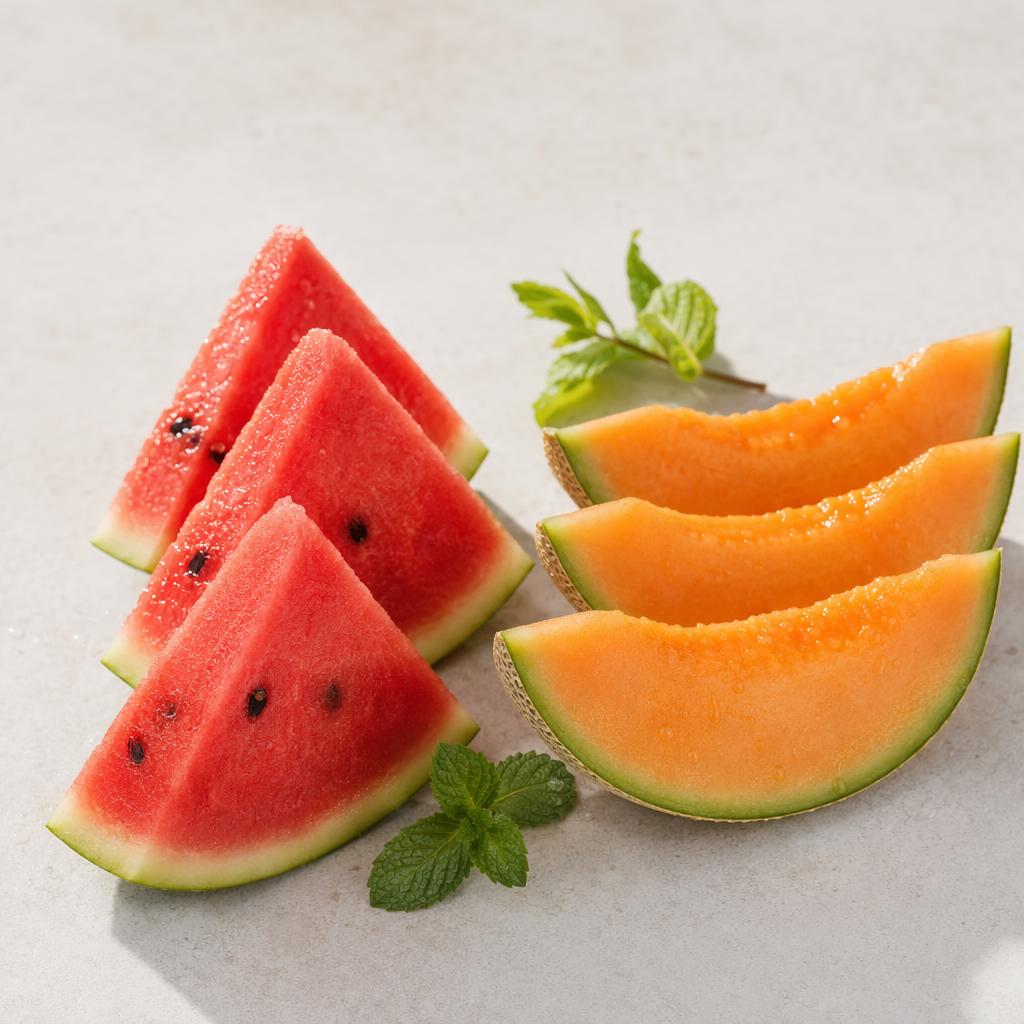
Watermelon vs melon: calories, glycemic index, and whether you can have them in a deficit
A by-the-numbers look at watermelon and melon — calories, glycemic index, and glycemic load. Which is lighter for a deficit, where the real catch is, and how to eat them without hurting weight loss.
Watermelon and melon are late-summer icons and an eternal question for anyone losing weight: "isn't that just sugar — can I have it in a deficit?" Short answer: yes. Let's break down by the numbers how they differ and where the real catch is.
Watermelon — ~30 kcal / 100 g, GI ~72
A 300 g slice = ~90 kcal. Watermelon is 92% water, which makes it one of the cheapest foods calorie-wise per volume. Its high glycemic index scares a lot of people — but that's misleading, and we'll get to why below. It has few carbs (~8 g per 100 g); they're just fast ones.
Melon — ~35 kcal / 100 g, GI ~65
A 200 g serving = ~70 kcal. Melon is a touch denser and sweeter than watermelon, with slightly more carbs, but the picture is the same: few calories per volume, lots of water. Cantaloupe (orange) and regular yellow melon are close in calories — the difference is within the margin of error.
The key point: GI isn't what people fear
Here's the confusion that unfairly brands watermelon as "bad."
The glycemic index (GI) shows how fast a food raises blood sugar — but it's measured on a fixed 50 g portion of carbs. And to get 50 g of carbs from watermelon, you'd have to eat over half a kilo. In a real serving there are few carbs.
That's why glycemic load (GL) matters more — it accounts not just for speed but for how many carbs are in the actual portion. For a reasonable serving of watermelon (150-200 g) the GL is low: the high index looks scary, but the real blood-sugar hit is small. It only climbs when you eat watermelon "by the half."
Put simply: a spoon of honey and a slice of watermelon can have a similar GI, but their effect on blood sugar is completely different.
Which is lighter for a deficit
By calories, watermelon and melon are nearly tied — both cheap by weight. The difference is in the details:
- Watermelon — more watery and slightly lighter, great for cooling off and filling your stomach with volume.
- Melon — sweeter and a bit more filling, slightly more carbs per 100 g.
Both fit comfortably into a deficit in a reasonable portion. The choice is purely a matter of taste.
Where the real catch is
Not in the calories per 100 g, but in the portion. Watermelon and melon get eaten in wedges to the point of stuffing yourself, straight from the middle — and half a watermelon is already 600-800 kcal. And because of the watery texture and fast carbs, the fullness is short-lived: an hour later you're hungry again and reaching for the next slice.
So the problem isn't watermelon itself — it's that it's hard to eat in small portions.
How to eat watermelon and melon in a deficit
- Measure the portion. Cut a piece onto a plate instead of spooning it out of the half. 200-300 g is a comfortable guideline.
- Add protein or fat for satiety. Watermelon with feta, melon with cottage cheese or a handful of nuts holds longer and smooths out the sugar spike.
- Count it as the day's carbs. Not "free water," but a real part of your total — then there are no surprises on the scale.
Takeaway
Watermelon and melon are great summer food for a deficit: few calories, lots of water and vitamins. Watermelon's high GI shouldn't scare you — in a reasonable portion the glycemic load is low. The only real risk is volume: counting the portion matters more than choosing between watermelon and melon.
In NutriApp, watermelon and melon are in the database — enter the weight of your slice and see right away how much of your day is left. And for a full rundown of summer fruits in a deficit, see our separate roundup.
So which team are you — watermelon or melon? Share it in the VK discussion.
Count calories automatically in NutriApp
Open NutriApp