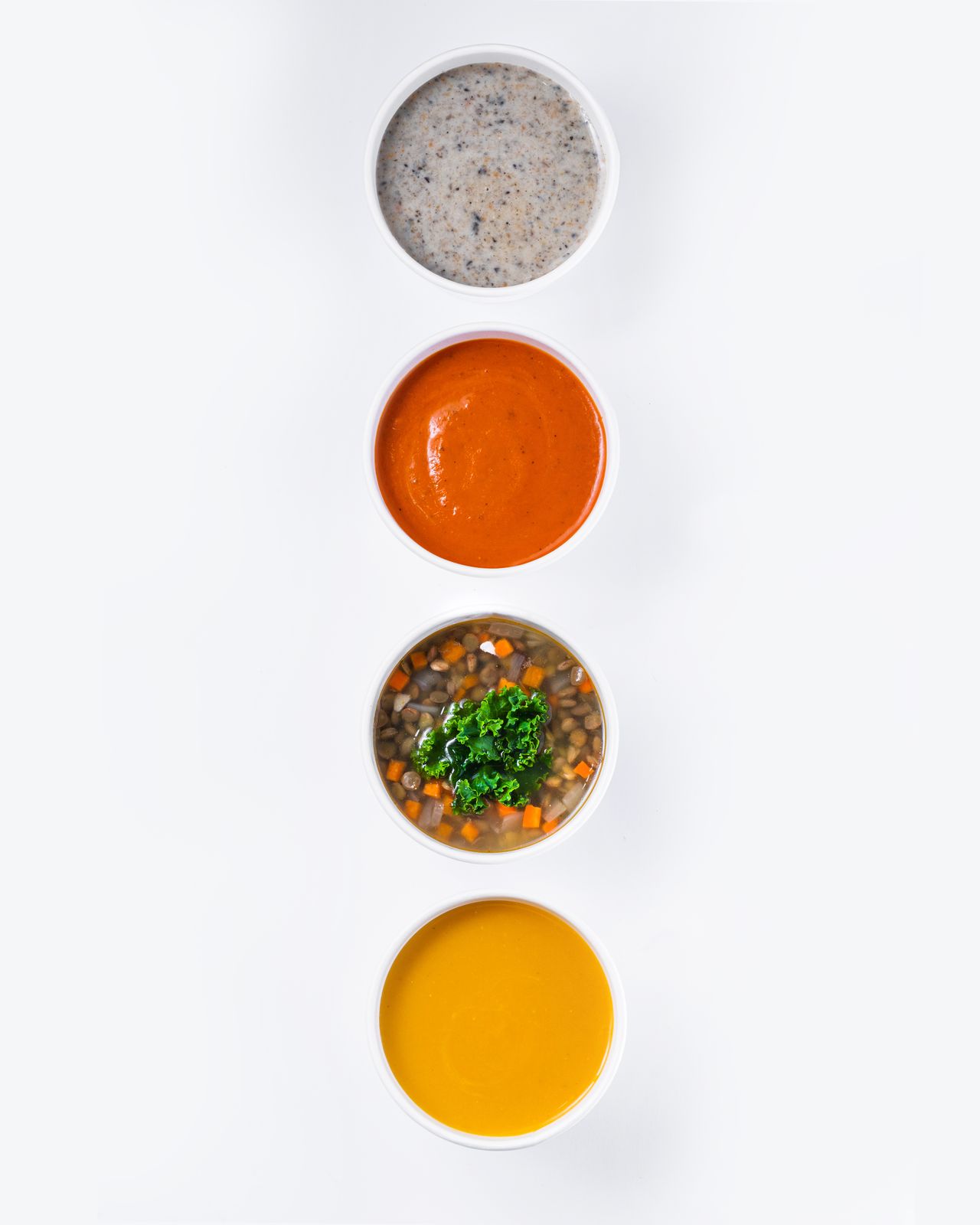
5 warm autumn soups under 250 kcal — pot quantities and macros
Five hot soups under 250 kcal a bowl — cabbage soup, mushroom soup, broccoli purée, chicken breast soup and red lentil soup. Quantities for a whole pot, macros per portion, and where the extra calories hide in soup.
In summer we put together cold soups under 250 kcal, and now it's time for something hot. That's good news for a deficit: soup is one of the most convenient lunches when you're counting calories. Lots of volume, lots of water, the bowl warms you up and fills you up, and it usually carries fewer calories than it seems.
Here are 5 warm options — each under 250 kcal per 300 g portion, with quantities for a whole pot and macros per bowl.
Why soup is a smart lunch in a deficit
Soup's main advantage is calorie density. Most of the bowl is water and vegetables, so 300 g of hot soup takes up as much room in your stomach as a dense main course while delivering two to three times fewer calories.
The second advantage is pace. You can't finish a hot soup in two minutes, so fullness has time to arrive while you're still eating. Hence the well-known effect: a bowl of soup at the start of a meal helps you eat less over the whole meal.
And the third — soup is easy to batch. A 4-portion pot covers lunch for two or three days, and you only have to count it once.
How we calculated
All recipes are for a 4-portion pot, roughly 1.2 kg of finished soup. Ingredient values come from the NutriApp database, water counts as zero, and per-portion numbers are rounded. We explained how the macros of a multi-ingredient dish are calculated in a separate post.
1. Fresh cabbage soup (shchi) — ~105 kcal (300 g portion)
P: 3 | F: 5 | C: 12
For the pot: white cabbage 300 g, potato 120 g, carrot 80 g, onion 60 g, tomato paste 20 g, vegetable oil 20 g, water ~600 ml.
A Russian classic that barely weighs anything calorie-wise yet is as filling as a "serious" lunch. Most of the calories here come not from the cabbage but from the spoon of oil for frying the vegetables — the cabbage for the whole pot is only about 80 kcal. For a more filling version, cook it with chicken breast: protein goes up noticeably, calories only slightly.
2. Mushroom and potato soup — ~115 kcal
P: 5 | F: 5 | C: 12
For the pot: button mushrooms 300 g, potato 250 g, carrot 60 g, onion 60 g, vegetable oil 15 g, water ~550 ml, fresh herbs.
Mushrooms give a rich, almost meaty flavor, so there's no need for cream or processed cheese. Button mushrooms are among the lightest foods in the database: 27 kcal per 100 g with 4 g of protein. Brown them in the same spoon of oil as the onion — it improves the soup more than any add-on.
3. Broccoli or cauliflower purée soup — ~105 kcal
P: 4 | F: 4 | C: 14
For the pot: broccoli or cauliflower 400 g, potato 150 g, onion 60 g, vegetable oil 15 g, water ~600 ml.
The potato is the secret to creaminess without cream: its starch makes the purée thick and velvety. The texture is like a restaurant cream soup, with noticeably fewer calories than the cream-based version. With cauliflower it comes out slightly lighter — about 100 kcal a bowl. Top with a spoon of yogurt instead of sour cream.
4. Chicken breast and vegetable soup — ~165 kcal
P: 20 | F: 4 | C: 11
For the pot: chicken breast 320 g, potato 200 g, carrot 80 g, onion 60 g, vegetable oil 10 g, water ~600 ml.
Unlike a canteen chicken noodle soup, which has very little meat, this one has ~80 g of breast in every bowl. That's where the 20 g of protein comes from — the most filling option in the list, easily lasting until evening. Cook the breast whole and slice it into the finished soup so it stays juicy.
5. Red lentil soup — ~215 kcal
P: 13 | F: 5 | C: 29
For the pot: red lentils (dry) 200 g, tomatoes 200 g, carrot 100 g, onion 80 g, vegetable oil 15 g, water ~700 ml, cumin and paprika.
Red lentils break down in 20 minutes and turn the soup into a thick purée on their own — no blender or cream needed. It's the most caloric soup in the list, but also the most filling: 13 g of plant protein plus plenty of fiber make it practically a complete lunch. We cover lentils and other accessible protein sources in a separate breakdown.
Where the calories hide in soup
The vegetables themselves weigh next to nothing — the calories come with what goes in alongside them:
- Frying oil. A tablespoon of oil is ~135 kcal. Every extra spoon in a 4-portion pot adds ~35 kcal to each bowl, and 2-3 generous ones add +65-100.
- Sour cream. A spoon of 20% sour cream is another ~40 kcal. 15% sour cream or yogurt is noticeably lighter.
- Bread. A slice with your soup is ~70-80 kcal. It almost never gets logged, even though it's half the calories of a light soup.
- Cream and processed cheese in cream soups. They're what turn 100 kcal into 300.
- Fatty meat on the bone instead of breast — the broth tastes richer but is noticeably more caloric.
How to make soup more filling, not more caloric
- Add protein: chicken breast, lentils, beans, an egg. Protein decides whether you'll be hungry an hour later.
- More vegetables, less potato. Potato is fine, but cabbage, carrot and broccoli give the same volume for fewer calories.
- Measure the oil. One measured spoon for frying keeps the soup light.
Takeaway
Warm soup is one of the best autumn tools for a deficit: 300 g of hot food for 105-215 kcal, plenty of vegetables, and 13-20 g of protein if you want it. The five recipes above cover the whole range — from very light cabbage soup to a dense lentil soup that replaces a full lunch.
In NutriApp you can build a soup from ingredients once and save it to "My dishes" — after that a bowl is logged in one tap, no recalculating. Sour cream and bread are easy to add as separate lines, so you see the honest total. For more seasonal ideas, see autumn foods in a deficit.
On Thursday we'll break down the soups people eat most often by calories: borscht, solyanka, kharcho and cream soups.
So what's your main autumn soup? Share it in the VK discussion.
Count calories automatically in NutriApp
Open NutriApp