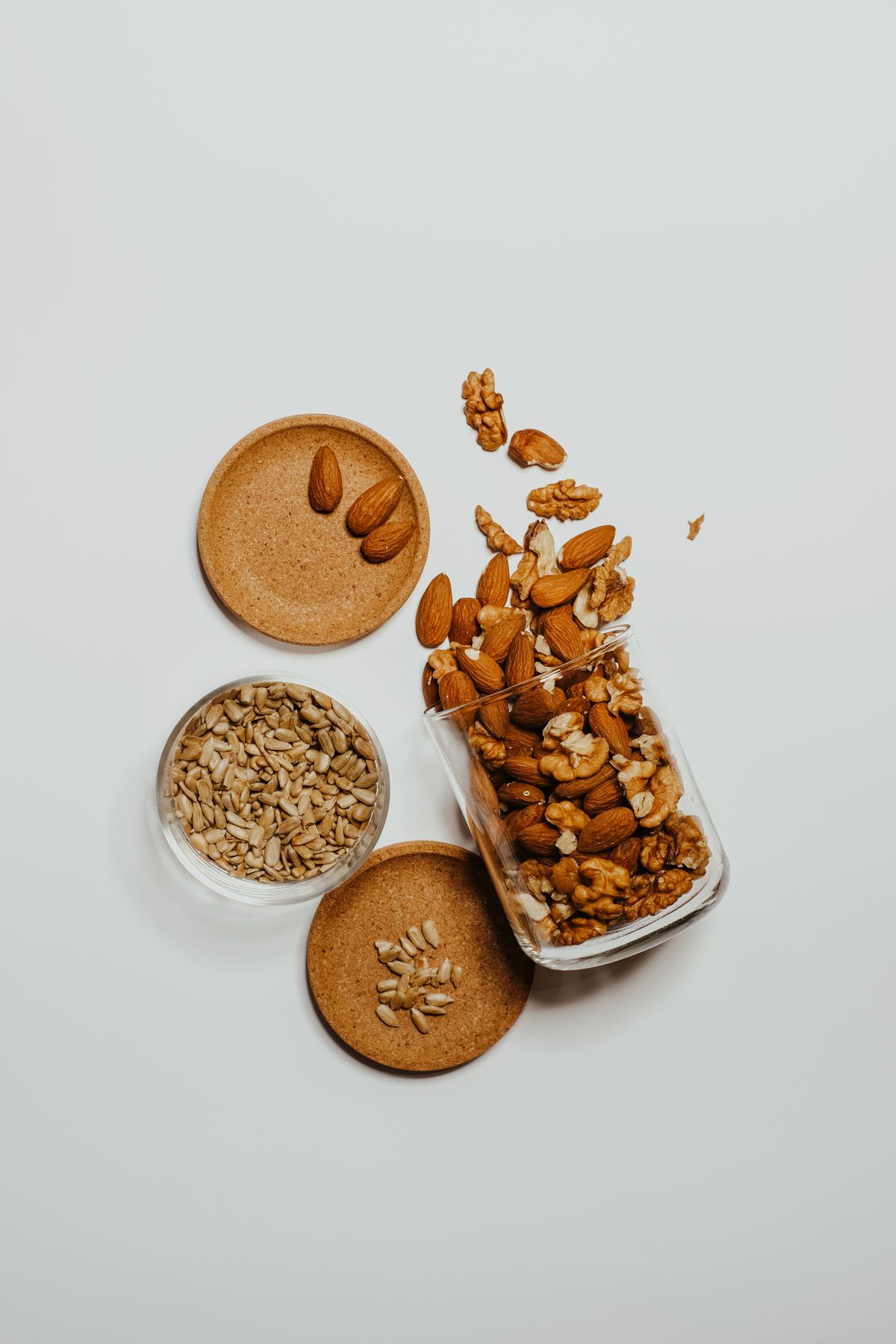
Nuts and dried fruit in a deficit: a handful is a snack, a bag is a dinner
How many calories are in a handful of almonds, cashews, pistachios and walnuts, how dried fruit compares to fresh, and how to eat nuts without blowing your deficit. Portions, numbers and four tactics that work.
Nuts are the trickiest food in a calorie deficit. They genuinely are good for you: fats, magnesium, plant protein, real satiety. But on calories they're the one food category that nearly catches up with butter — 718 kcal per 100 g for macadamias against 748 for butter.
The problem isn't the nuts, it's that people eat them straight from the bag and never log them. Here's what a normal portion actually looks like, with numbers from the NutriApp food database.
A handful is 30 g, not "however much you grabbed"
Here's what one handful costs:
- Cashews — ~166 kcal (P 5.5 | F 13)
- Pistachios — ~167 kcal (P 6 | F 14)
- Pumpkin seeds — ~167 kcal (P 7 | F 14)
- Peanuts — ~170 kcal (P 8 | F 15)
- Almonds — ~183 kcal (P 6 | F 16)
Any of those handfuls is a full snack, comparable to a pack of cottage cheese. The difference is that cottage cheese takes up room in your stomach, while a handful of nuts disappears in a minute and leaves almost no fullness behind.
Heavier for the same handful:
- Hazelnuts — ~195 kcal
- Walnuts — ~196 kcal
- Pine nuts — ~202 kcal
- Macadamias — ~215 kcal
Why nuts are so easy to overeat
It isn't willpower — it's three things at once:
- Volume doesn't match calories. 30 g of nuts is two mouthfuls and 180 kcal. To get the same from cucumbers you'd have to eat over a kilogram.
- They're eaten in the background. Nuts almost always accompany something else: a series, work, a conversation. Food you don't notice doesn't get counted — not in your head and not in your diary.
- The pack doesn't end at one portion. A standard 150 g bag of almonds is 913 kcal. Finishing it over an evening is easy, and that's a full dinner with dessert.
Dried fruit isn't the "light" alternative
Dried fruit is two to three times lighter than nuts, but it's still a concentrate: the water is gone, the sugar stayed.
- Dried apricots, 30 g — ~65 kcal
- Prunes, 30 g — ~69 kcal
- Dried figs, 30 g — ~77 kcal
- Raisins, 30 g — ~79 kcal
- Dates, 30 g — ~82 kcal
Compare that with fresh: apricots are 44 kcal per 100 g against 215 for dried; grapes are 65 against 264 for raisins.
One important caveat: piece for piece there's barely any difference. One dried apricot is made from one apricot and costs about the same calories. The trap is speed. A 30 g handful of dried apricots is three to four fresh ones, and 100 g of raisins is roughly 400 g of grapes — a large bunch. You'd spend twenty minutes on the bunch and twenty seconds on the raisins.
Nut butters: a spoon costs more than it looks
- Cashew butter — 587 kcal per 100 g
- Peanut butter — 588 kcal
- Almond butter — 614 kcal
A level tablespoon is 20 g, about 118 kcal. Two spoons on toast plus the bread itself, and a "light breakfast" is already pushing 300 kcal. Serve it with a spoon rather than a knife straight from the jar — from the jar the portion is always bigger.
Four tactics that actually work
- Pour a portion and put the bag away. Tip a portion into a bowl, close the bag and take it back to the kitchen. It's the one tactic that works without a scale.
- Buy the ones you have to crack. Pistachios and walnuts in the shell physically slow you down, and the pile of empty shells shows how much you've already had.
- Put nuts into food instead of eating them alone. 10 g in a salad, porridge or yogurt gives you the flavour and crunch for 60 kcal — not the 200 that vanish out of a bag.
- Treat them as food, not a garnish. A handful of nuts is a snack, and it takes its place in the day's budget alongside a yogurt or a sandwich.
The takeaway
There's no need to cut nuts and dried fruit out: they carry the fats, protein and fibre a deficit usually lacks. But they're not "healthy food without consequences" — they're a calorie concentrate that needs a portion and a diary entry.
A simple rule: a 30 g handful is a snack, a 150 g bag is a dinner. Anything in between is worth weighing for a while, until your eye is calibrated.
In NutriApp every nut, dried fruit and nut butter is its own entry, so a handful doesn't need mental arithmetic. Other snacks with ready-made weights are collected in a separate post.
Do you weigh your nuts, or go by eye? Tell us in the VK discussion.
Count calories automatically in NutriApp
Open NutriApp