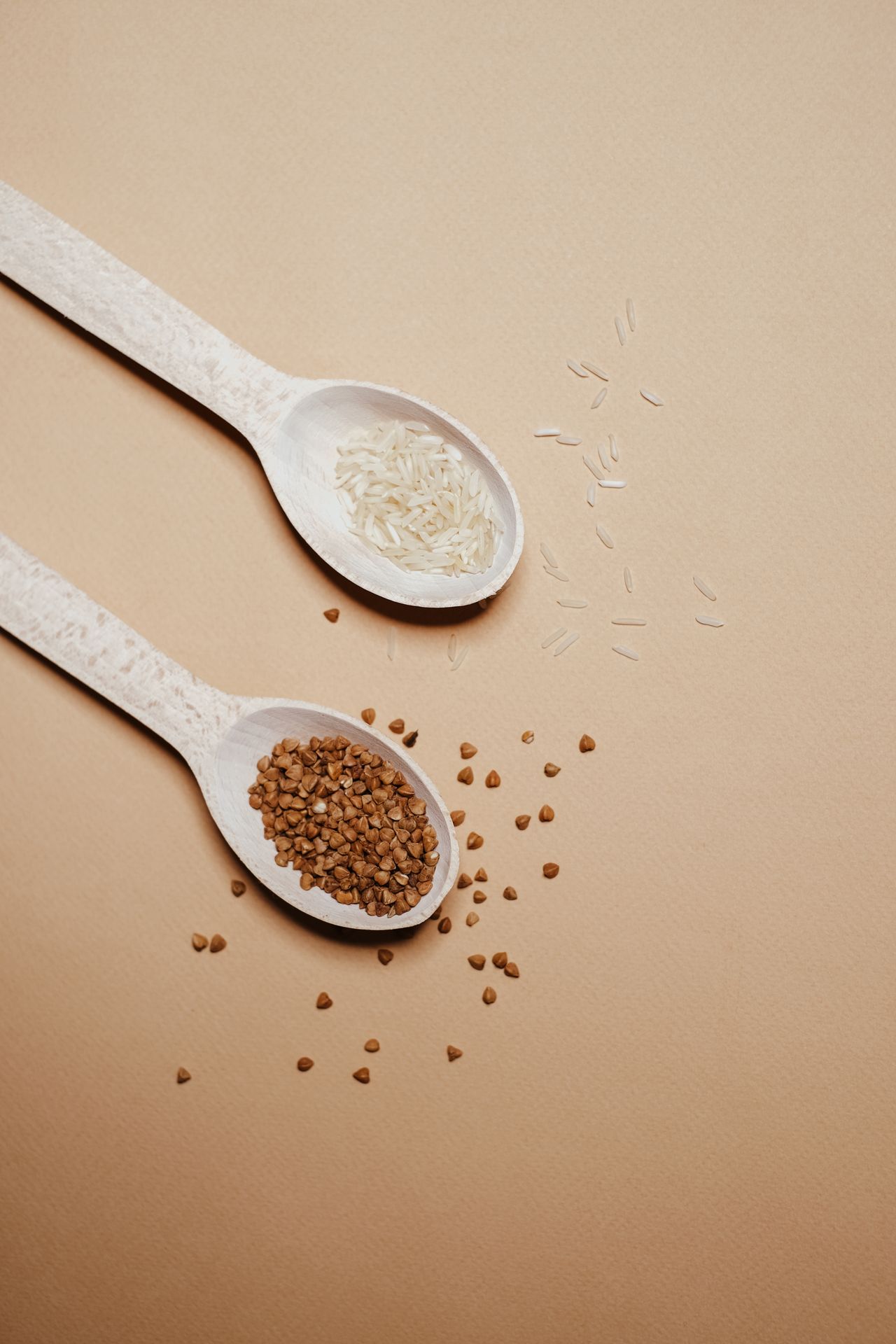
Buckwheat: 313 or 110 kcal? How to count grains and pasta correctly
Why buckwheat, rice and pasta each have two different calorie values — one dry, one cooked. The two typical diary mistakes that throw your count off by hundreds of calories, and two ways to count that actually work.
The most common mistake in calorie counting isn't a forgotten sweet or "a bit of mayo". It's buckwheat — or rather, the confusion between dry grain and cooked porridge. It can make a diary wrong by 300-400 kcal a day, while the person genuinely wonders why "I count everything and the weight won't move".
On Tuesday we covered side dishes and their calories. Today: how not to be off by a factor of three.
One grain, two different numbers
Calories per 100 g, dry and cooked:
- Buckwheat — 313 kcal dry → 110 kcal cooked
- White rice — 344 kcal dry → 130 kcal cooked
- Pasta — 350 kcal dry → 131 kcal cooked
For reference, other grains dry: rolled oats — 366, pearl barley — 315, bulgur — 342, couscous — 376, quinoa — 368. All of them "lighten" by the same 2.5-3 times once cooked.
Why — it's the water
Calories don't disappear during cooking. The grain simply absorbs water and gets 2.5-3 times heavier: buckwheat about 2.8 times, rice 2.6, pasta 2.7.
Concretely: 60 g of dry buckwheat is 188 kcal. After cooking you get around 170 g of porridge — and it's the same 188 kcal. Same energy, different weight, therefore a different "per 100 g" figure. Water adds no calories and removes none.
Mistake 1: weighed it dry, logged it as cooked
The most common scenario. You measure out 60 g of grain, cook it, and log "cooked buckwheat, 60 g".
- In the diary: 66 kcal
- In reality: 188 kcal
That's 120 kcal missing from one portion. Count a side dish that way twice a day and you're up to nearly 1,700 unlogged calories a week — the deficit exists in the diary but not in real life.
Mistake 2: weighed it cooked, logged it as dry
The reverse case, and it's no better. You put 200 g of cooked porridge on the plate and pick "buckwheat (dry)" in the app.
- In the diary: 626 kcal
- In reality: 220 kcal
Here the diary scares you: it looks like half the daily target went into a side dish, so you start cutting portions, walk around hungry and break down a week later. Inflated numbers do as much damage as missing ones.
Two ways to count that work
Option 1 — weigh the grain dry. The most accurate one: how much water gets absorbed depends on how long and in what you cook it, while the calories in the dry product are fixed. Measure 60 g, log "buckwheat (dry), 60 g", and it doesn't matter whether the result came out crumbly or soft.
Option 2 — weigh the cooked food. More convenient when someone else cooks or the pot is shared. Put 180 g on your plate, log "cooked buckwheat, 180 g".
The main rule: don't mix the two in one entry. Both mistakes above are always an attempt to weigh one thing and log another.
If the porridge is cooked for the whole family, there's a third path: weigh the entire pot, count it as one dish and divide it into portions. We explained how that works in the app in the post on calculating recipe macros.
Potato: same story, but from the cooking method
Here the weight barely changes, but the cooking method does — and the numbers spread fourfold (per 100 g):
- Boiled potato — 77 kcal
- Baked — 93 kcal
- Mashed — 106 kcal
- Fried — 192 kcal
- French fries — 312 kcal
The same vegetable. So in the diary it matters that you pick the version that actually ended up on your plate, not just "potato".
And the mirror image: meat gets "heavier"
Meat behaves the opposite way to grains. It loses water, becomes denser, and 100 g of the cooked product carries more calories than 100 g raw: chicken breast is 113 kcal raw and 130 kcal grilled. The gap isn't as dramatic as with grains, but if you always weigh in the same state — raw or cooked — there's no confusion.
Don't forget the add-ons
A spoon of butter in your porridge is +75 kcal, a handful of grated cheese +70. It's often these, not the grain itself, that make a side dish heavy: buckwheat with butter and cheese is 310 kcal, not 165.
Takeaway
A grain always has two numbers and both are correct — the only question is what you put on the scale. Weigh it dry or cooked, but log exactly the state you weighed. It's a single habit that removes the biggest systematic error in a food diary.
In NutriApp dry and cooked grains are separate entries, and the name says which is which: "Buckwheat (dry)" and "Cooked buckwheat". You pick the one you actually weighed. Other common counting mistakes are collected in a separate breakdown.
So do you weigh your grains dry or cooked? Share it in the VK discussion.
Count calories automatically in NutriApp
Open NutriApp