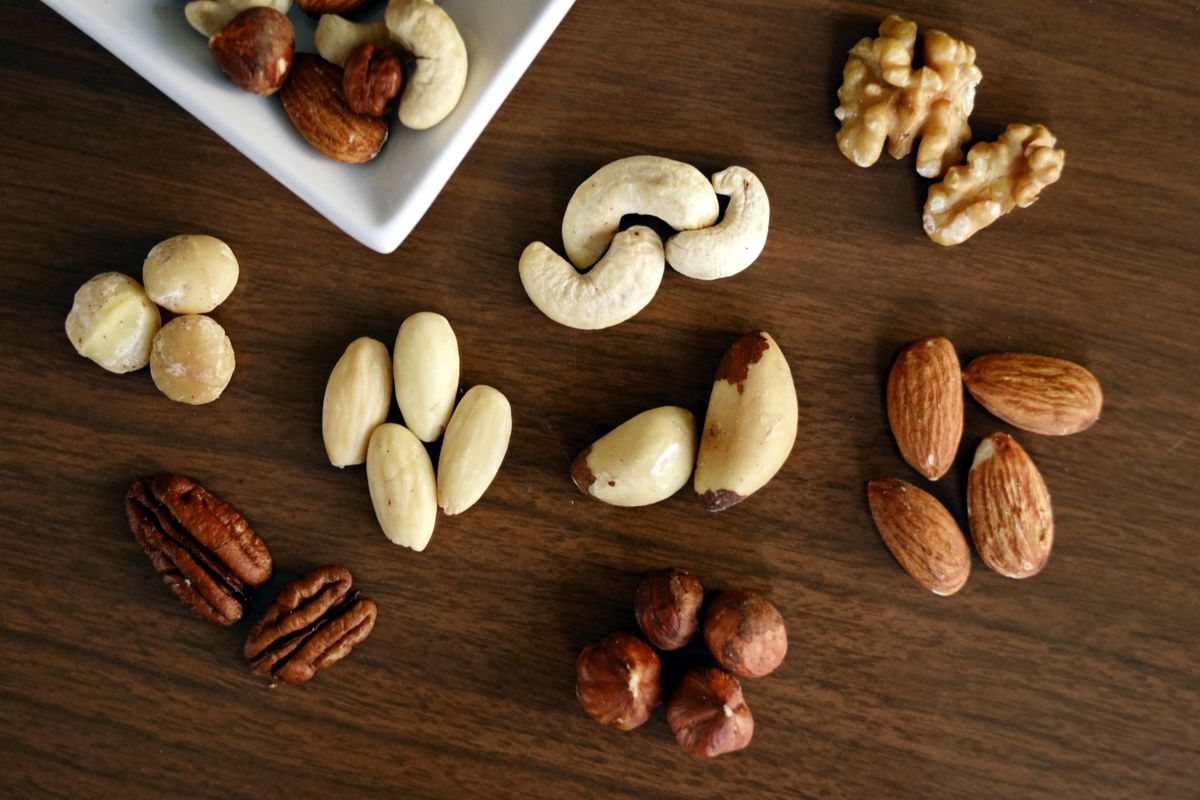
Calories in nuts: from pistachios to macadamias — and why chocolate is lighter than a walnut
A full calorie table for nuts, seeds, dried fruit and nut butters. Why the whole spread comes down to fat, which nuts are lightest, and why nuts aren't a protein food even though they hold plenty of protein.
On Tuesday we counted portions of nuts and dried fruit; today it's the full table. And it's worth starting with the number that usually starts an argument.
Dark chocolate is 550 kcal per 100 g. A walnut is 654
On calories, chocolate is lighter than almost every nut. Milk chocolate, at 554, is lighter too.
That's not a reason to switch to chocolate: nuts carry unsaturated fats, fibre, magnesium and plant protein, while a bar is mostly sugar. But it is a good reason to stop sorting food into "healthy, no need to count" and "unhealthy, must count". Calories come from what's in the food, not from its reputation.
The real difference is in how they're eaten: people notice a bar of chocolate and don't notice a handful of nuts.
Nuts and seeds: the table per 100 g
- Chia seeds — 486 kcal (P 16.5 | F 30.7)
- Flax seeds — 534 kcal (P 18.3 | F 42.2)
- Cashews — 553 kcal (P 18.5 | F 43.9)
- Hemp seeds — 553 kcal (P 32 | F 49)
- Pistachios — 556 kcal (P 20.2 | F 45.3)
- Pumpkin seeds — 556 kcal (P 24.5 | F 45.8)
- Peanuts — 567 kcal (P 26.3 | F 49.2)
- Sesame seeds — 573 kcal (P 19.4 | F 48.7)
- Sunflower seeds — 578 kcal (P 20.7 | F 52.9)
- Almonds — 609 kcal (P 18.6 | F 53.7)
- Hazelnuts — 651 kcal (P 15 | F 61.5)
- Walnuts — 654 kcal (P 15.2 | F 65.2)
- Brazil nuts — 659 kcal (P 14.3 | F 67)
- Pine nuts — 673 kcal (P 14 | F 68.4)
- Pecans — 691 kcal (P 9.2 | F 72)
- Macadamias — 718 kcal (P 7.9 | F 75.8)
The spread is about 1.5x, and it comes down entirely to fat: from 30.7 g in chia to 75.8 in macadamias. Carbs and protein are broadly similar across the list, so "which nut to pick" is a question of fat content — exactly as it is with cuts of meat or the fat percentage on cottage cheese.
The pattern is neat: the lightest nuts are also the most protein-rich. Peanuts, pumpkin seeds, pistachios and cashews give the most protein for the fewest calories. The heaviest — macadamias and pecans — are the poorest in protein.
Nuts are not a protein food
Nuts really do hold a lot of protein: 26 g per 100 g in peanuts, 32 in hemp seeds. But the number worth looking at is protein per 100 calories, not per 100 grams:
- Cottage cheese 0% — 23 g of protein per 100 kcal
- Chicken breast — 21 g
- Hemp seeds — 5.8 g
- Peanuts — 4.6 g
- Pumpkin seeds — 4.4 g
- Almonds — 3.1 g
- Walnuts — 2.3 g
- Macadamias — 1.1 g
That's a five- to twentyfold gap. Nuts are fat first, with protein as a bonus. If the job is to hit your protein target, other foods do it; if the job is satiety and good fats, nuts are excellent.
Dried fruit, per 100 g
- Dried apricots — 215 kcal (P 5.2 | C 51)
- Prunes — 231 kcal (P 2.3 | C 57.5)
- Dried figs — 257 kcal (P 3.1 | C 57.9)
- Raisins — 264 kcal (P 2.9 | C 66)
- Dates — 274 kcal (P 2.5 | C 69.2)
Drying removes the water, not the calories. Grapes are 65 kcal per 100 g, raisins 264 — four times more. Apricots are 44, dried apricots 215 — nearly five times.
Piece for piece, though, there's barely a difference: one dried apricot is made from one apricot. The trap isn't the pieces, it's the speed — a 30 g handful of dried apricots is three to four fresh ones, and 100 g of raisins is roughly 400 g of grapes, a large bunch. You'd spend twenty minutes on the bunch and twenty seconds on the raisins.
Nut butters
- Cashew butter — 587 kcal per 100 g
- Peanut butter — 588 kcal
- Almond butter — 614 kcal
A level tablespoon is 20 g, about 118 kcal. Butters end up heavier than the nuts they're made from when there's added oil or sugar, so the ingredient list matters: a good one holds nuts and salt, nothing else.
What else moves the number
- Roasting. Roasted sunflower seeds are 601 kcal against 578 raw. Roasting drives off water while the fat stays, so 100 g of roasted costs slightly more.
- Salt and glaze. Salted and honey-roasted nuts differ not because of the salt but because of the oil and sugar in the coating — log those as their own entries rather than as plain "nuts".
- Nuts inside dishes. In granola (450 kcal per 100 g), bars and salads the nuts are already counted — there's no need to add them as a separate line.
The takeaway
Every nut is expensive; the gap between them is within about 1.5x, and fat decides it. Dried fruit is three times lighter but is concentrated sugar. Butters are the same nuts, just easier to eat more of.
One practical conclusion: nuts and dried fruit are food, not background. As long as they're counted as food, they cause no trouble at all, even in a deficit.
In NutriApp every nut, dried fruit and butter is its own entry with exact macros, roasted versions included. What a normal portion looks like, and how to stop at one, is in Tuesday's post.
Are nuts a snack for you, or an addition to a meal? Tell us in the VK discussion.
Count calories automatically in NutriApp
Open NutriApp